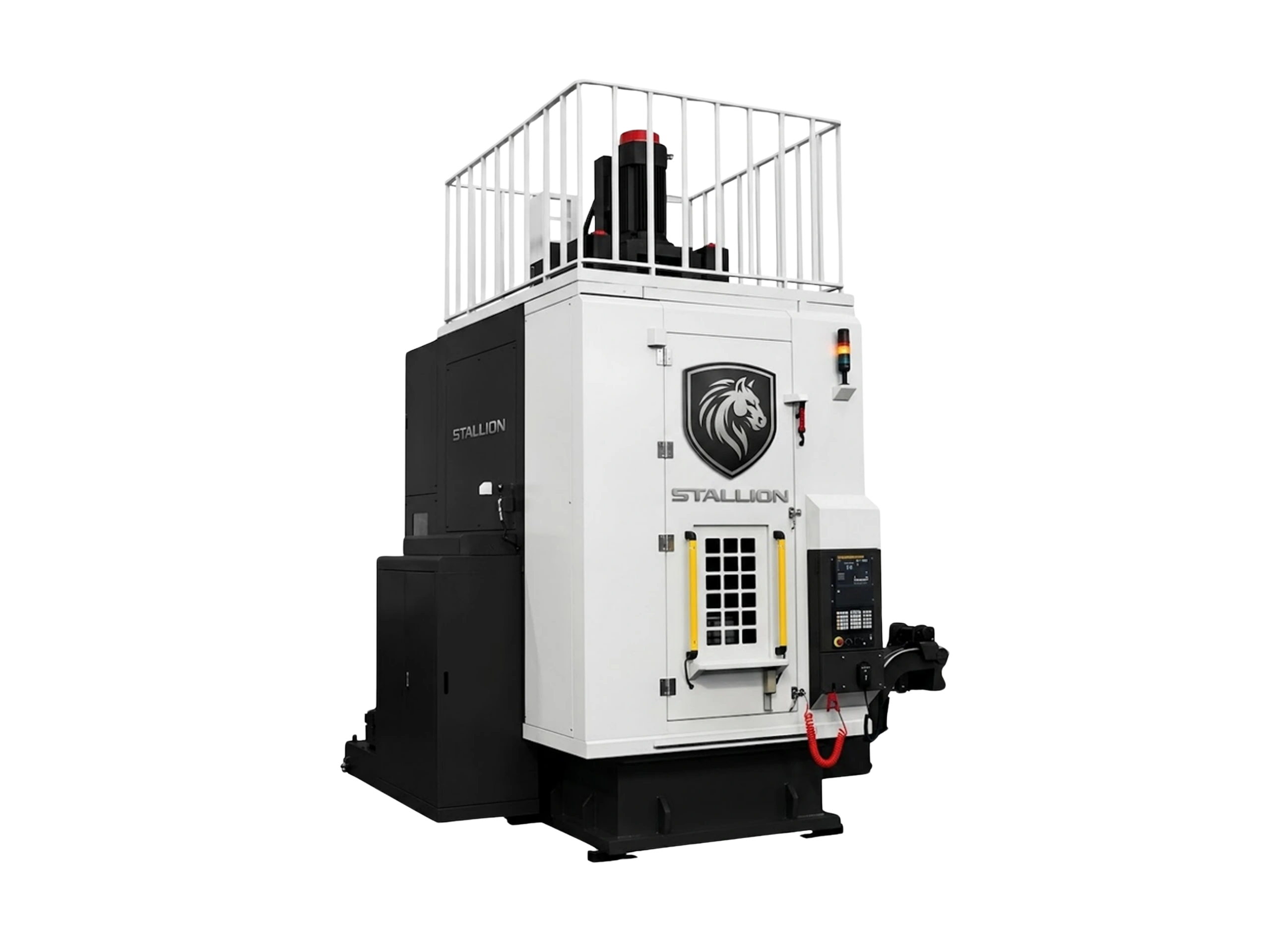
CNC Broaching Machine
Comprehensive Broaching Portfolio · Configured to Your Application.
Full Specifications
Broaching Portfolio · Configuration & Force Range
| Configuration | Pull / Push Force | Typical Stroke | Typical Applications |
|---|---|---|---|
| Vertical Pull-Up Broaching | 50 – 400 kN | Up to 1,600 mm | Internal splines, gear teeth, high-volume auto components |
| Vertical Pull-Down Broaching | 100 – 600 kN | Up to 2,000 mm | Long internal splines, transmission shaft profiles |
| Vertical Surface (Push-Down) Broaching | 100 – 1000 kN | Up to 2,500 mm | External surfaces, slots, flat profiles, connecting rods |
| Horizontal Internal Broaching | 100 – 500 kN | Up to 3,000 mm | Long internal profiles, keyways, large bore splines |
| Horizontal External / Surface Broaching | 200 – 1000 kN | Up to 3,000 mm | Large external splines, flange end teeth, surface profiles |
| Helical / Spiral Broaching | 50 – 400 kN | Configured to profile | Helical spline internal teeth (servo-driven rotation) |
Frequently Asked Questions
What types of CNC broaching machines does Stallion offer? +
The Stallion CNC broaching portfolio covers six major configurations: vertical pull-up, vertical pull-down, vertical surface (push-down), horizontal internal, horizontal external/surface, and helical/spiral broaching. Each is offered across a force range from 50 kN to 1000 kN and is configured to the customer's component, profile, stroke length and production volume.
What profiles can be broached on Stallion platforms? +
Internal splines (parallel, involute and helical), keyways (square and rectangular), square and hexagonal holes, polygonal profiles, gear teeth (small modules), flange end teeth and custom contour shapes. External broaching covers flat surfaces, slots, large external splines and surface profiles. Any profile that can be defined as a swept cross-section is typically broachable.
What is the difference between push, pull, vertical and horizontal broaching configurations? +
Pull broaching pulls the broach through the workpiece — favours longer broaches and higher pull forces. Push broaching pushes shorter broaches through — typical for shorter internal profiles. Vertical broaching uses a vertical ram (smaller footprint, gravity-assisted loading); horizontal broaching uses a horizontal ram (easier for long parts and automation integration). Stallion offers all configurations across the force range.
Which industries use Stallion CNC broaching machines? +
Automotive driveline (spline shafts, hub broaching, steering components), off-highway and heavy-duty transmission (large internal splines), reducer and gearbox manufacturing, bearing manufacturing (cage broaching), gear manufacturing (keyway and spline cutting in finished gears), and precision engineering — wherever high-volume internal or external profile cutting is required.
Why is the Stallion broaching portfolio superior to competitor offerings? +
The Stallion broaching portfolio spans every configuration from 50 kN to 1000 kN — vertical, horizontal, push, pull, helical — on platforms built with full digital AC servo or hydraulic drive systems, rigid cast-iron structures and CNC stroke control for consistent cutting force, predictable tool life and dimensional repeatability across long production runs. Critical components including hydraulic systems, AC servo drives, precision bearings and CNC controls are sourced from leading international suppliers across Japan, Germany, Taiwan and Europe for maximum quality and long-term broaching accuracy.