Additive Manufacturing
Industrial 3D printing for Indian production — sand, pattern, metal and full-colour.
Full Specifications
Stallion's additive manufacturing portfolio combines two proven industrial additive technologies. The ST Series Industrial 3D Pattern Printer — Stallion's flagship, launched at IFEX 2026 — uses Fused Granulate Fabrication (FGF), a direct pellet extrusion process in which standard thermoplastic pellets are fed into a heated servo-driven screw extruder and deposited layer by layer. FGF moves beyond the constraints of standard FDM/FFF filament printing, eliminating proprietary filament costs and dramatically increasing build speed and scale. The sand, metal and full-colour printers in the range use binder jetting — a powder-bed process in which a print head selectively deposits a binding agent onto successive powder layers, bonding the material into a solid part one layer at a time. Both technologies are selected for the specific application demands of Indian industrial production.
Industrial Sand 3D Printer
BINDER JETTING · FOR FOUNDRY MOULD PRODUCTION
Stallion's industrial sand 3D printer directly prints casting moulds and cores from CAD data — bypassing the pattern-making step entirely. The machine builds sand moulds layer by layer using binder jetting technology, producing geometries that conventional pattern-making either cannot achieve or cannot achieve economically. Typical Applications- Direct printing of sand moulds for iron, steel, aluminium and copper-alloy casting
- Complex internal geometries impossible with conventional patterns
- Low-volume, high-mix casting production
- Rapid prototyping for new casting designs
- Foundry tooling acceleration for automotive, valve, pump and energy components
- Eliminates conventional pattern-making
- Lead-time reduction up to 90%
- Prints cores, undercuts and channels in one operation
- Build envelopes from compact to industrial scale
- Engineered for Indian foundry conditions
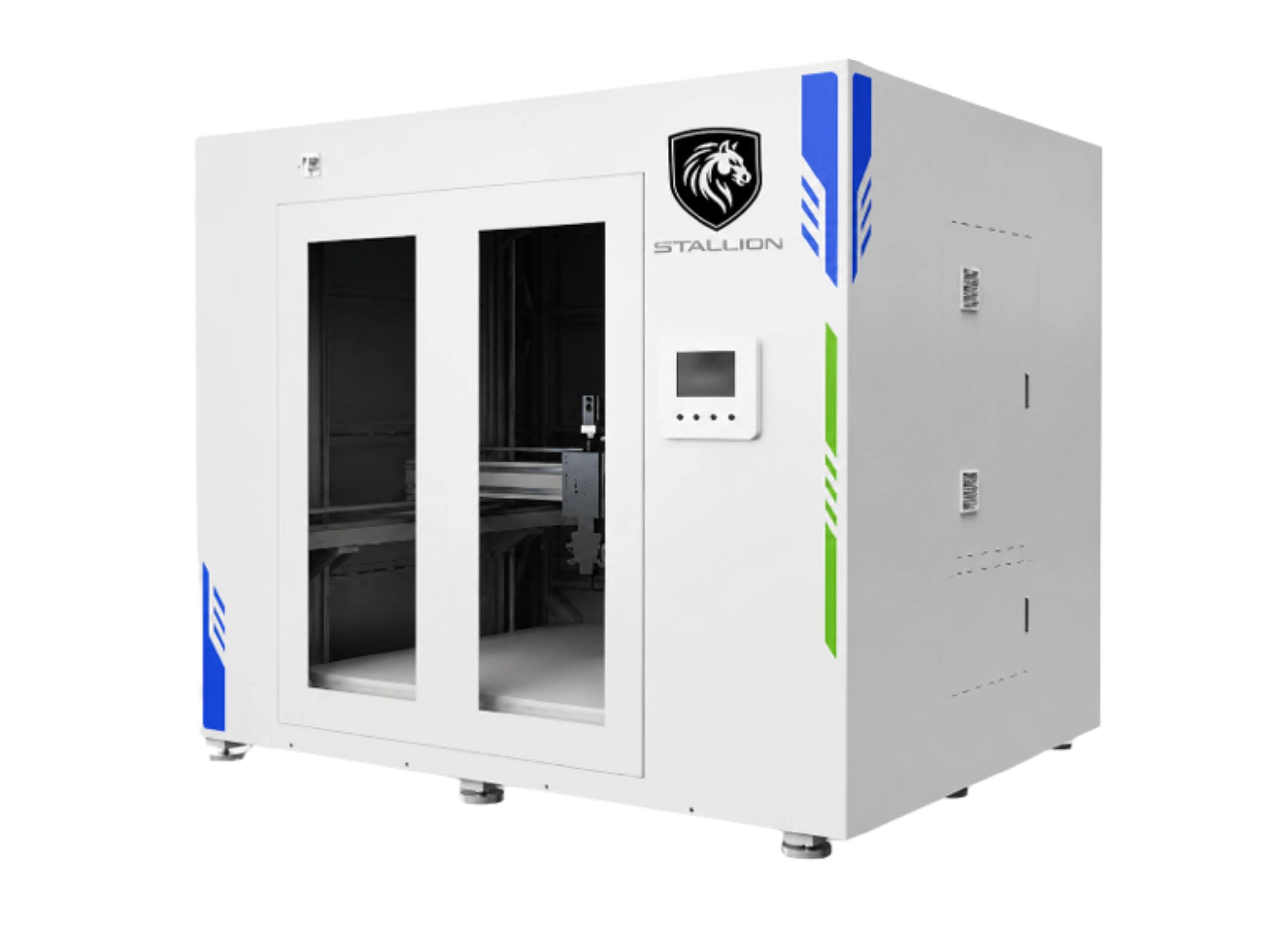
ST Series Industrial 3D Pattern Printer
FLAGSHIP · FUSED GRANULATE FABRICATION (FGF)
Stallion's flagship additive product engineered specifically for mould and pattern making. Using direct pellet extrusion technology, the ST Series delivers significantly higher build speeds, lower material costs and larger build volumes than traditional filament-based systems. Typical Applications- Foundry patterns for sand casting
- Match-plate patterns and assemblies
- Core boxes
- Mould tooling
- Large-format prototype components
- Direct pellet extrusion technology
- Up to 20 kg/h extrusion speed
- Build volumes up to 5000 × 4000 × 2000 mm
- Servo-controlled positioning
- Supports industrial thermoplastics and composites
Industrial Metal 3D Printer
METAL BINDER JETTING
Industrial metal additive manufacturing system designed for production-scale metal part manufacturing using binder jetting technology. Typical Applications- Functional metal prototypes
- Complex internal geometries
- Tooling inserts
- Custom fixtures
- Automotive and aerospace components
- Faster than laser-based systems
- Lower production cost
- Wide material compatibility
- Industrial throughput capability
Full-Colour 3D Printer
GYPSUM POWDER BINDER JETTING
Full-colour additive manufacturing platform for design verification, architecture, education and medical visualisation. Typical Applications- Architectural models
- Medical and anatomical models
- Industrial design verification
- Research and education
- Full-colour printing in one operation
- High resolution output
- Fast build speeds
- Lower operating cost
The Technologies Behind The Range
Fused Granulate Fabrication (FGF)
Fused Granulate Fabrication (FGF), also known as direct pellet extrusion, is an industrial additive manufacturing process that uses standard thermoplastic pellets and fibre-reinforced composites. Materials are fed directly into a servo-driven screw extruder and deposited layer-by-layer to build large-scale parts. Unlike conventional filament printing, FGF eliminates filament costs, expands material choices and significantly increases build speed and production scale. The ST Series delivers up to 20 kg/h extrusion capacity and build volumes up to 5000 × 4000 × 2000 mm.Binder Jetting
Binder jetting is a powder-bed additive manufacturing process used for sand, metal and full-colour printing. Layers of powder are selectively bonded using an industrial print head, building parts directly from CAD data. Compared with laser-based additive manufacturing, binder jetting offers faster production rates, larger build volumes and lower energy consumption while maintaining excellent dimensional accuracy.Industries Served
Frequently Asked Questions
What additive technologies does Stallion use, and why? +
Stallion's additive range combines two proven industrial additive processes, each selected for the application it serves best. The ST Series Industrial 3D Pattern Printer — Stallion's flagship, launched at IFEX 2026 — uses Fused Granulate Fabrication (FGF), a direct pellet extrusion process. Standard thermoplastic pellets (PP, ABS, PLA, PETG, PPS, ASA) and fibre-reinforced composites (carbon fibre, glass fibre, basalt fibre) are fed into a heated, servo-driven screw extruder and deposited layer by layer. FGF moves beyond the constraints of standard FDM/FFF filament printing, eliminating filament costs and dramatically increasing build speed and scale — up to 20 kg/h on the ST5040T model with a build volume of 5000 × 4000 × 2000 mm. The Industrial Sand 3D Printer, Industrial Metal 3D Printer and Full-Colour 3D Printer use binder jetting — a powder-bed process in which a print head deposits binding agent onto successive layers of powder, bonding the particles into a solid part. Application drives technology selection — not the other way around.
What can Stallion's sand 3D printer actually do for a foundry? +
Stallion's industrial sand 3D printer directly prints casting moulds and cores from CAD data — eliminating the conventional pattern-making step entirely. For a foundry, this removes the largest single bottleneck in the casting workflow. Pattern-production lead times that previously ran into weeks compress to days. Labour requirement falls dramatically. Complex internal geometries impossible with conventional patterns become routinely producible. And for low-volume, high-mix casting work, the unit economics shift substantially in the foundry's favour.
Can Stallion's metal 3D printer produce production-grade parts? +
Yes. Stallion's industrial metal 3D printer uses binder jetting followed by sintering to produce fully dense, functional metal components in stainless steel, tool steels, copper, Inconel and a range of other industrial alloys. The technology is optimised for production runs where laser-based metal additive is either too slow or too expensive — making it suitable for small-series production, tooling inserts, conformal cooling applications and complex geometries that cannot be machined conventionally.
How does industrial 3D printing economics compare to conventional manufacturing? +
For low-to-medium volume production and high-complexity parts, industrial 3D printing is consistently more economical than conventional manufacturing. The crossover point depends on the specific application — Stallion's application engineering team will assess the customer's part, volume and complexity to determine whether additive, conventional or a hybrid workflow delivers the best unit economics. For foundries replacing conventional pattern-making, the economics typically favour additive from the first production batch.
Does Stallion provide installation, training and ongoing support for additive equipment? +
Yes — the same five-step Stallion process that supports the CNC range applies to additive equipment. Stallion's engineering team handles installation, commissioning, operator training and lifetime AMC support. Genuine spares are held in inventory pan-India through Stallion's service network. For first-time additive adopters, Stallion's application engineering team also provides workflow consulting — designing the customer's complete pattern-to-casting or part-to-finish workflow around the new equipment.