Unmanned Production Lines
Lights-out manufacturing engineered for Indian factories.
Full Specifications
What Stallion Engineers in an Unmanned Production Line
Why Indian Manufacturers Are Moving to Unmanned Production
Typical Applications
Frequently Asked Questions
Does Stallion engineer brake disc, brake drum and knuckle production lines? +
Yes. Stallion engineers complete production lines for all three automotive workpieces — brake disc production lines, brake drum production lines and steering knuckle production lines. Each line is engineered around the customer's specific part-print, cycle target and volume requirements. Stallion's brake disc production line work has included the consolidation of four CNC machines into three for a Tier-1 automotive customer (documented in the Case Studies section). The same engineering approach extends to brake drum and knuckle production: consolidated machining operations, robotic loading, gantry transfer, in-process inspection and the controls layer that allows the line to run with minimal human intervention.
What is an unmanned production line? +
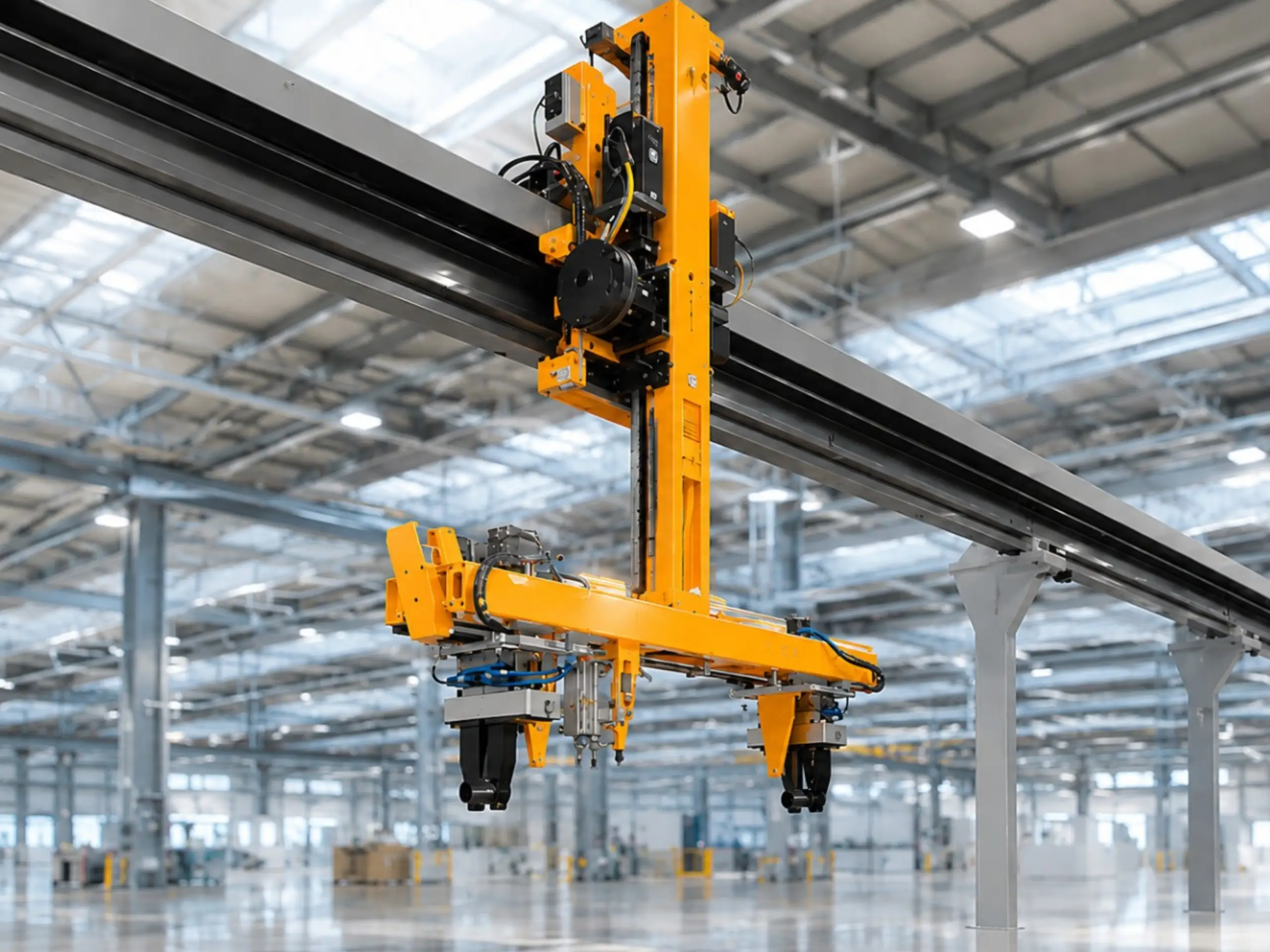
An unmanned production line is a fully automated manufacturing cell in which every machining, handling, inspection and material-flow operation is automated to the point that the line can run a complete production shift — and typically multiple consecutive shifts — without human intervention. Operators perform only supervisory tasks: monitoring the line, responding to alarms, performing scheduled maintenance and managing material supply at line-entry and line-exit.
Does Stallion build the robots itself, or supply third-party robots? +
Stallion engineers the complete production line in-house — process design, machine selection, layout, end-of-arm tooling, controls integration and commissioning. The industrial robots themselves are sourced from leading global robot manufacturers, selected for the specific application. The customer receives a single point of accountability for the entire line, regardless of which components come from which source.
Can Stallion automate an existing production line, or only build new ones? +
Both. Many of Stallion's most demanding engagements involve re-engineering an existing customer line — consolidating operations, introducing robots and gantries in stages, and progressively moving the line toward unmanned operation. Brownfield automation is often more complex than greenfield, because the engineering must work within existing constraints. Stallion has deep experience in both.
What is the typical payback period on an unmanned production line? +
Payback varies with the application, the volume and the existing labour cost. For typical Tier-1 automotive applications running three shifts, payback periods of 18 to 36 months are common. For high-mix, lower-volume work the payback period extends, and the business case shifts toward consistency and traceability rather than labour replacement. Stallion's application engineering team performs a complete techno-commercial assessment as part of the proposal process.
How does Stallion ensure an unmanned line stays running once commissioned? +
Predictive maintenance through Stallion's AMC department, supervisory monitoring built into the controls layer, scheduled service visits, and genuine spares held in inventory pan-India. Stallion's service network is engineered to keep production lines running through their full asset life — the same discipline applied to individual CNC machines for the past 25 years, scaled up to line level.
Who at Stallion leads the unmanned production line engagements? +
Unmanned production lines are led by Stallion's Joint Director, Mr. Sanjay P. S. — a trained robotics engineer who holds an MS in Robotics from the University of Sheffield (UK). Mr. Sanjay heads the Robotics & Automation department at Stallion. Every automation project is personally engaged by the Joint Director and supported by Stallion's specialised application engineering, controls and service departments.